
Portrayal of Eleanor in Eleanor & Park by Rainbow Rowell

Literature has always played an important role in forming a particular image about women and the constructing certain gender norms. We tend to idealize the characters we admire and try to imitate them in our lives. Sometimes, we also align our beliefs with the ones of the author, if the story is able to make such an impact.

A book such as Eleanor & Park may seem like an ordinary romance novel but the portrayal of the female protagonist, Eleanor, helps to make some important deductions about how women are represented in contemporary literature by female authors.

Having the name of the main character as the title of a novel usually signifies he/she is a strong character. In the case of Eleanor & Park, while two characters share the title, we know the focus is on Eleanor, as her name appears first. Also, it is noteworthy how Rowell cleverly named her character. Eleanor relates to light/brightness (often associated with the Queen Eleanor in the story) but her character attempts to stay low and not draw attention to herself. Ironically, we also see her as a highly sensitive girl who instead of standing up against the bullies, wouldn’t dare utter a word and chooses to remain silent.

After building a weak image of Eleanor, we are made aware of her family background (separated parents), physical appearance, which didn’t fit the definition of the usual beauty standards (bullied as a ‘fat chipette’), and constant indications to her manly personality, be it attraction towards Park’s comic books or her wearing ‘a giant men’s shirt’. As a critical reader, it meant that if a woman does not have certain feminine traits, she should not be recognized as one. We also know that Eleanor is an honors student yet her intelligence is overpowered by her appearance.  

Despite this, her love-interest to-be, Park, finds her very red curly hair, with dark brown eyes, appealing. As we see the novel normalizing these features as beautiful, reference to her ‘white skin’ later, proves us wrong. Being a reader from Pakistan, a country that obsesses over white complexion, from finding gori bahus (daughter-in-laws) to endorsing whitening products to become ‘beautiful’, such colorist remarks can be extremely harmful for the youth and the wider audience. In the 21st century, when we should be promoting the idea of being comfortable in our own skin, reading such literature that uses ‘whiteness’ of a female character as a scale of beauty, can hinder that progression, and further undermine the image of women with darker complexions.

Not only that, Park’s comparison of Eleanor with his mother, reminded me of the common desi mindset – neglecting a woman’s individual personality and finding similarities between her personality and a man’s epitome of womanhood.

The imposition of patriarchal values continued in the story with Eleanor’s mother grabbing books with male protagonists at random, when packing to shift, and the ones around women (or equally about them) not making the cut – Oliver’s Story was given preference instead of Lovestory and Little Men was included but not Little Women.

Fast forwarding to the end, Eleanor eventually becomes a victim of violence and threats from her evil stepdad, Richie, and is saved by Park, who drives Eleanor to her uncle in Minnesota. Eleanor’s rescue was not unexpected but ending with them parting confirms that only the ‘ideal’ woman deserves permanent happiness and to be loved. Park ultimately goes to prom with another girl but the damsel in distress Eleanor does not forgo her attachment with him.

From the desi mindset we come from, Park would resemble any typical South-Asian male, who would not want to be associated with a woman, coming from such a background. Thought of as a matter of integrity, cutting ties with Eleanor and moving on seemed like the most appropriate thing to do. Eleanor, being a naïve, innocent girl, is still hopeful for it to work.

Eleanor & Park is one of the most celebrated novels of Rainbow Rowell and would have been an exemplary and inspiring work, in my opinion, if Eleanor was shown as a strong-minded woman, an attribute that drew Park’s attention. Seeing such a woman who confronted her fears instead of escaping could be a source of courage for many.

We can only expect to see a positive change in the way female protagonists are depicted in books, in the near future.

‘Sanya Mithani is a content writer at Femmerang. She’s a lifestyle Instagram blogger passionate about books.

Follow her on Instagram’
And if Instagram can be linked to her blog on Instagram.
Female authors in contemporary literature

Book reviews

One of Us Is Lying by Karen M. McManus:

“You find out who your real friends are when stuff like this happens. Turns out I didn’t have any…” 
― Karen M. McManus, One of Us Is Lying

If you are a murder mystery fanatic, you are in for a treat. An ordinary classroom detention turned into a crime scene when Simon Kelleher dies from a severe allergic reaction after drinking from the cup with traces of peanut oil, leaving the other four in detention as suspects; Bronwyn Rojas, the nerd, Addy Prentiss, the popular prom queen, Cooper Clay, the baseball enthusiast, and Nate Macauley, the bad boy with a criminal record. 

‘Everybody’s got secrets’ and those secrets were made public on Simon’s gossip app, About That, serving as a possible motive for his savage murder. As rumours float around about the darkest secrets of the Bayview four, after being broadcasted on the new blog, About This, post Simon’s death, the audience is compelled to believe one of them is to be held accountable. But who could go this far to guard their secret?

The four suspects narrate each chapter (first person point of view), which is quite commendable as the author wrote from the perspective of four different people, switching the tone of writing each time to better suit their personalities. While Addy’s concerns revolved around being the second-runner up at the beauty pageant, ‘homecoming princess, not queen’ at one point, Bronwyn was someone who took pride in not being featured once on Simon’s app, claiming she was ‘too squeaky-clean for that’. On the other hand, Nate’s gauche personality as a result of his broken family was apparent in his speeches, with the constant use of slangs. And lastly, Cooper was simply in the endeavour to live up to his image and father’s expectations, and not let any distractions come in his way of becoming the baseball star. McManus made sure you get a sneak peak into the lives of each one, to build empathy and connection, and give an opportunity to draw conclusions. 

One of the recurring themes in this novel is friendship. You will encounter friends showing their true colours and turning their backs, in unpleasant situations, leaving the protagonists to confide in each other and those outside their social circles. Even Maeve’s character, transitioned from just Bronwyn’s younger sister to being her deuteragonist and a trustworthy friend. Her clever, courageous and determined self makes her my favorite among all.  

As a final verdict, I would rate this fast-paced, contemporary YA fiction a 4.5/5. This page-turner is packed with a rattling good climax, filmic narration, convincing characters and a hard-luck antagonist – all the ingredients present for a gripping suspense read. 

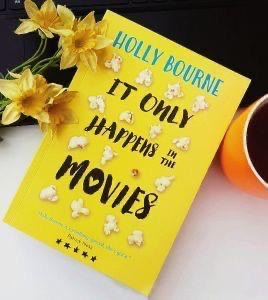
It only happens in the movies by Holly Bourne:

“The class divide”. Check.

“The bad boy who changes his ways just for you”. Check.

“The chance encounter”. Check.

“The formal event”. Check.

“The big mistake”. Check. 

“The grand gesture”. Check.

The happily ever after?

This is what you’d expect to find in a typical love story. But not this one. Rather, you will find Bourne mocking the stereotypical depiction of perfect relationships and cliché endings, in romantic movies. 

Audrey, just seventeen, has not only seen her parents drift apart but is going through a dreadful breakup phase. While she was trying to get over love and relationships, she meets Harry and it all seems too perfect but for how long?

After every few chapters, you will come across the practical-Audrey ranting about how ‘it only happens in the movies’. For instance, how everyone bumps into everyone in romance movies, especially their love interest, the chance of which, in reality, is nearly impossible. But it happens! The light-hearted humour in these little sarcastic segments in-between will make you grin. 

Moreover, the protagonist, while firm about her believes about love is quite vulnerable to love too. The uncertainty and the internal conflict (of Audrey), will keep you at the edge of your seats, as to what decision will she make next and whether it will prove right for her. 

Bourne also touches upon some sensitive and serious themes such as depression and gender discrimination. Bourne illustrates the miserable condition of Audrey’s mother after her divorce in a way that will break your heart. On the other hand, the author also emphasizes upon the male-dominated culture, where men can get away with anything. Be it Audrey’s father, who left them for another woman, yet escaped the blame, or her brother, who always got away with all the responsibilities.  

Another reason to pick up this book this instant is the ending. The ideal end you would expect from a book that defies the norms. While it will make you weep, you will be content with the way it concluded. I personally would have hated it if it were otherwise. 

My rating for this book is a strong 4.5/5. The kind of book you would prefer picking up after a long stressful day to lighten up the mood. All the emotions gathered in one place, you would resonate with the characters and lose yourself in the story.